
The Hopkins Blacksmith Shop at Windmill Village
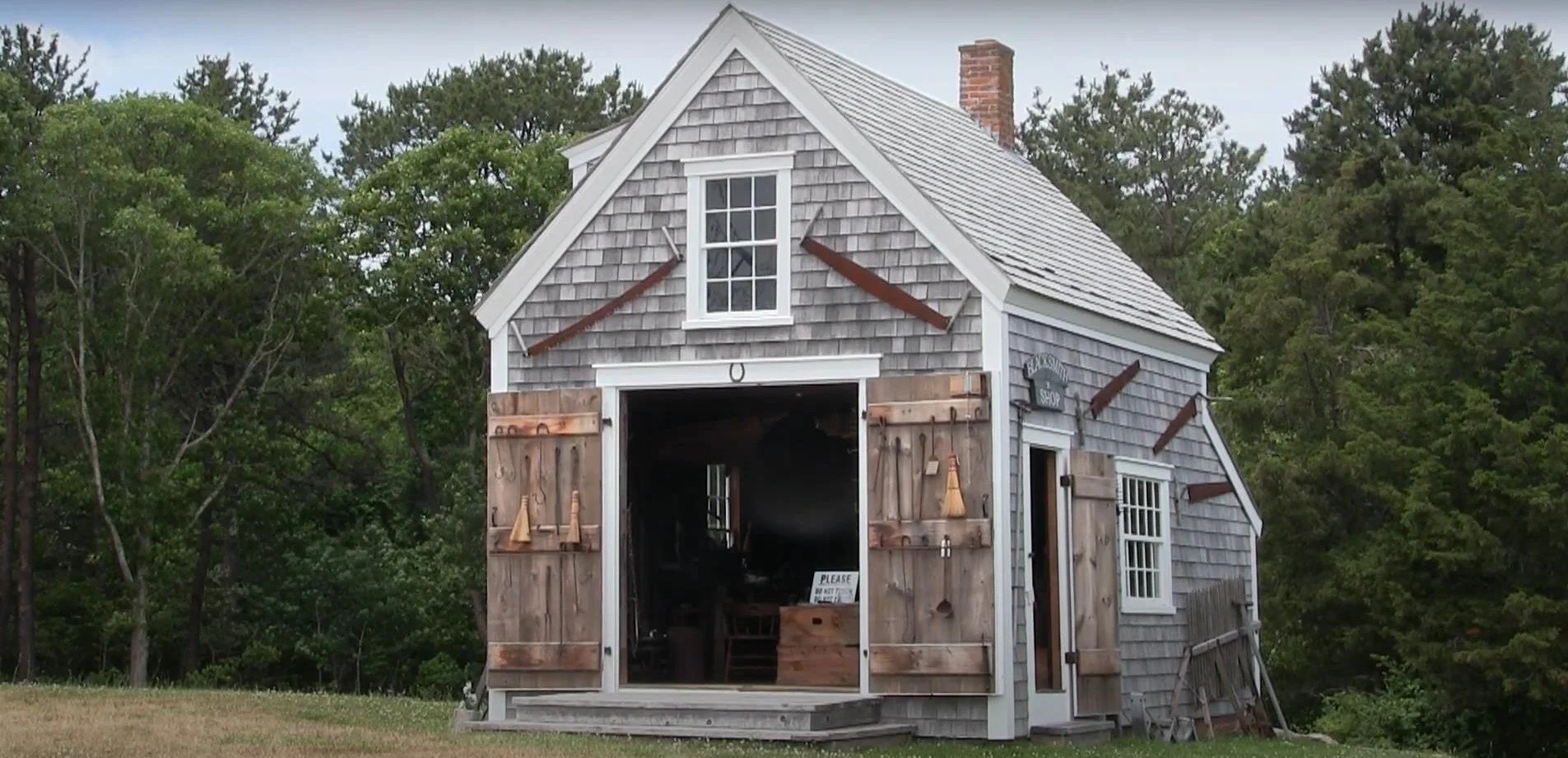
Hopkins Blacksmith Shop at Windmill Village
Henry Hopkins was born in 1845 the son of housewright Moses Hopkins, Jr. He lived at 463 Long Pond Road. At the age of 22, with his father Moses, he built a blacksmith shop on their property across the street at 4 Depot Road, where he shod horses and made hinges, hooks and pulleys, among other tools. He also built a carriage-making shop and a wheelwright shop. Carriages and wagons were built on the first floor behind large wooden doors and then hoisted by hand-forged pulleys to the window-lighted loft above, where they were painted and left to dry. All that Henry needed for his enterprise he made on his property. He had a harness shop, machine shop, and across the street, a post-windmill that turned a wooden lathe.
In 1870, at age 25, Henry married Keziah Paine of Harwich. They had seven children: Geneva, Fannie, Ruth, Jennie, Sumner, and two children who died. Around 1889, Henry built a house at 812 Tubman Road, across the street from his family home. It was there that he grafted apple trees in his orchard, kept beehives, hunted ducks and made his own decoys. Keziah and Henry’s youngest daughter, Jennie, married Mike Cummings, Brewster’s first fire chief. Jennie made the upholstery for all of her father’s carriages. The descendants of Henry Hopkins planted a chestnut tree in front of the carriage shop in his memory and it blooms there today.
In 1972, the blacksmith shop was sold to the New England Fire and History Museum and moved to the museum’s site on route 6A. In 1973, while at the Fire and History Museum, the blacksmith shop underwent restoration. A new roof was put on and the chimney of original Birmingham brick was taken apart and rebuilt. As was the case at its original site, the shop had no cellar and appeared to rest on bricks. Inside, the original wood forge stood as it always did; Henry Hopkins’ original anvil was mounted on a ship’s mast beside it, along with two bellows and many original tools. For many years, the shop provided visitors with valuable insight into an earlier way of life in Brewster, but when the Fire Museum closed, the blacksmith shop slowly decayed.
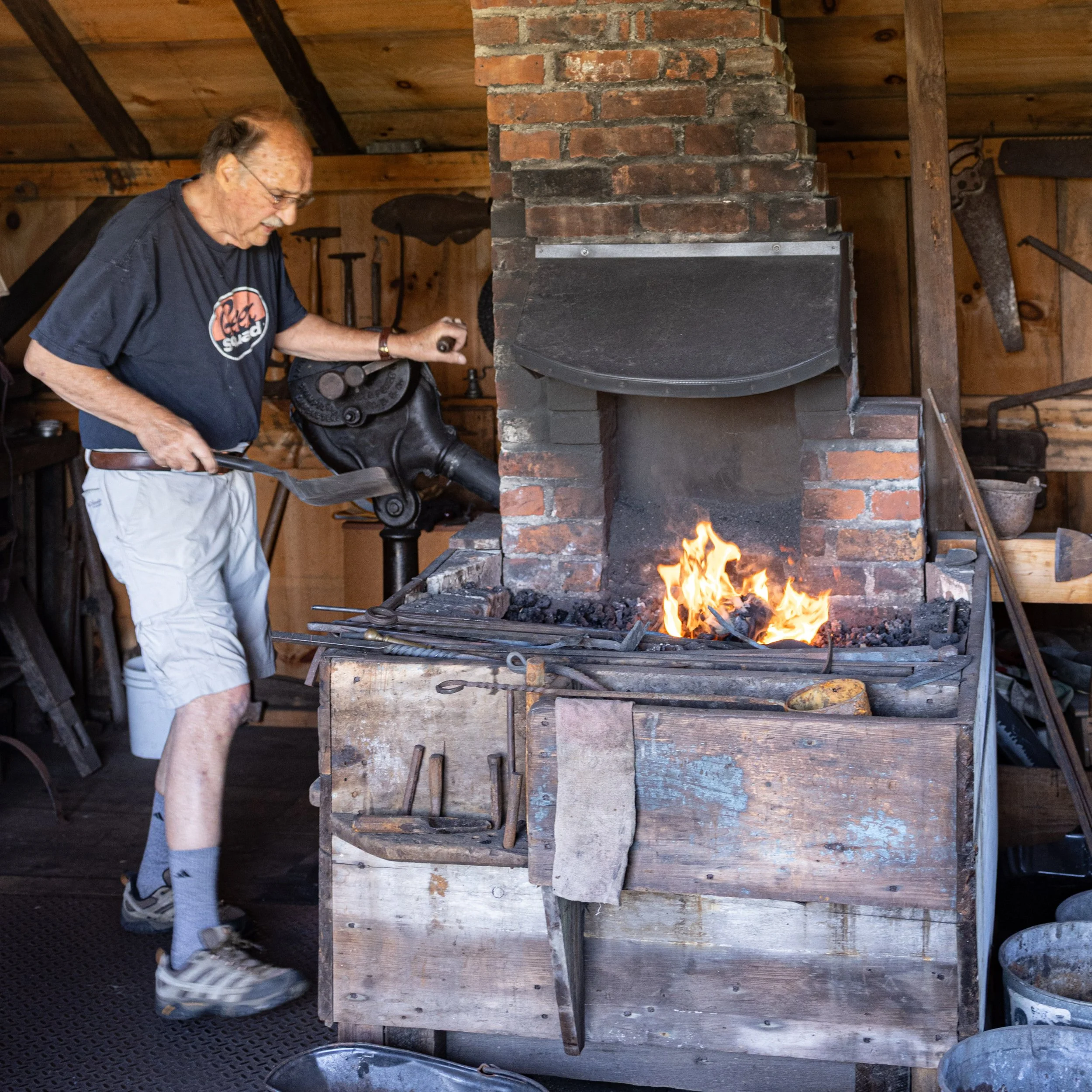
Blacksmith at the wood forge
In 2009, The Brewster Historical Society acquired the shop and moved it to their property adjacent to Drummer Boy Park at 51 Drummer Boy Road, where it sits alongside the Higgins-Farm Windmill and the Harris-Black House. With community support via Community Preservation Act funds, the shop was restored to a condition as nearly authentic as is possible today, accurately recreating a period when the art of blacksmithing was at its height the world over – the second half of the nineteenth century.
All the tools in the Hopkins Blacksmith Shop are hand-powered; there is no electricity in the shop except that which is required for public safety. The blowers, drills, and grinding tools are all hand cranked.
One of the most unusual features of the shop is its wood forge – most restored forges seen today are made of stone or brick, because a wood forge seldom survives the ravages of time.
Combine all of these features and the Hopkins Blacksmith Shop now stands as one of the most unique and important historical sites on Cape Cod today.
- This article is offered in grateful memory of Nancy Cannon and Janet Hicks, longtime Brewster Historical Society volunteers, who researched and composed this history for the Society.
~ ~ ~
The Brewster Historical Society Windmill Village at 51 Drummer Boy Road, Brewster, is open Friday through Sunday 12 – 3 PM until September and Saturdays 12-3 PM through October
